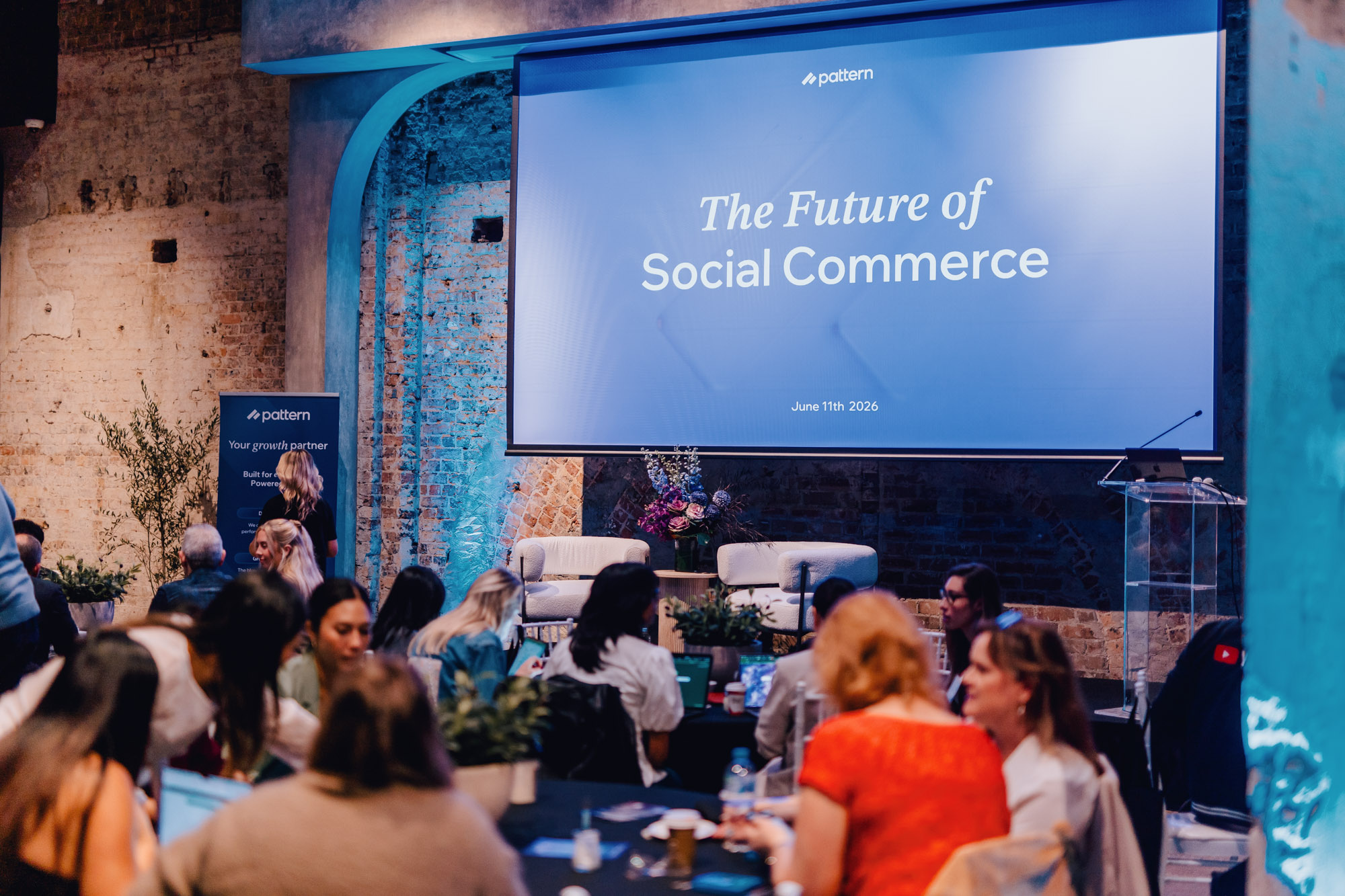
On June 11 we brought together brand leaders, platform partners, and ecommerce teams for a full day focused on where social commerce is heading and what it takes to win on it. We heard directly from YouTube, Pinterest, and TikTok, and our own Pattern social team covered Meta and Reddit. A lot was covered, so here are the most useful parts for the brands who weren’t in the room.
Before the event, we ran a survey of attendees. 58% said converting social content to sales was their number one challenge. 88% wanted to learn about TikTok Shop ahead of its Australian launch. Only 25% felt they were producing content at scale. That last gap, between being on the platforms and actually feeding them, was the common thread that ran through most of the day.
The Australian opportunity is bigger than most brands are treating it
Australian social commerce is expected to hit $13 billion by 2030, more than doubling from where it sits today. According to Pattern’s own 2026 Marketplace Consumer Report, 67% more shoppers are now starting their purchase journey on social media, and among 18 to 34 year olds, a large majority say they’re more likely to purchase a product a creator recommends. When social does influence a purchase, over a third of those consumers go directly to the brand’s website to buy.
Bethany Carr, Pattern’s Head of Social, set the context in her opening session: “The brands winning at social commerce aren’t choosing one platform. They’re building a system where each channel earns its place in the funnel.” That framing is worth keeping in mind, as the most common mistake we see is brands treating each platform as a standalone bet, rather than part of a connected strategy.
The other number that stuck from Bethany’s session: 62% of young Australians are aware of shoppable ads, but only 23% have actually purchased through one. Consumer readiness is there. The gap is in the experience – the content isn’t native enough, the creative isn’t compelling enough, and the purchase path isn’t seamless enough. That’s fixable, and it’s where the brands that get moving now will build a real advantage.
YouTube: it’s not just top of funnel anymore
Tim Hosking, Regional Product Lead for YouTube at Google, opened with some numbers that reframe where YouTube sits in the media mix. YouTube now reaches 96% of adult Australians every month, which is 20.1 million people, and 13.3 million of them are watching on their TV screens each month – more reach across the connected TV screen than all the free-to-air networks combined. Analytic Partners’ Media Mix Modelling ranks YouTube as the number one channel for long-term ROAS, delivering 2.4 times more than social and 2.5 times more than TV.
For brands thinking about where to invest in the second half of 2026, the practical focus areas Tim highlighted were Demand Gen campaigns, YouTube Shorts, and creator partnerships. Shorts now reaches 16 million logged-in Australians monthly, and 57% of those users aren’t on TikTok, so there’s genuine incremental reach on offer that most brands aren’t accessing. The YouTube Shopping Affiliate Program is also coming to Australia, which means the creator and affiliate infrastructure you build now will pay dividends when that launches.
The creative principles that drive performance on YouTube are worth taking seriously: Tim walked through YouTube’s ABCD framework (Attention, Branding, Connection, Direction), and ads built to those principles drive a 31 to 38% improvement in sales lift and ROAS compared to those that aren’t. Brands running Demand Gen campaigns with video in all three aspect ratios see an average 5% uplift in conversions. These aren’t huge lifts in isolation, but they compound.
Meta: stop fighting the algorithm and start feeding it
Shauna McKillop, Pattern’s Senior Social Account Manager, gave what was probably the most practically useful session of the day. Her core argument: Meta’s AI has become an additional media buyer, and the brands losing on the platform right now are mostly the ones still trying to manually override it rather than working with it.
Meta’s own data shows that 56% of campaign performance is driven by creative quality, more than audience targeting, placement, or budget combined. Brands running five or more creative variations per ad set see 35% lower average CPMs than those running a single asset. “I’ve seen this play out so many times,” Bethany noted earlier in the day. “A brand significantly increases creative output and their cost per purchase drops without changing a single other variable. The creative is the strategy.”
The practical implication is to shift resource from audience and bidding optimisation toward creative production and testing. Meta’s new media upload workflow makes this more accessible than it used to be: upload up to 10 asset variations and let the algorithm test combinations. For an apparel brand Shauna tested this with, it delivered 46% higher CTR, 25% higher ROAS, and 41% more revenue compared to a traditional carousel format.
On measurement, Shauna also introduced Meta’s new incremental attribution model, which lets brands see how much revenue was actually caused by their ads versus what would have happened without them. For anyone still reading 7-day click attribution as gospel, this changes the picture considerably, and it’s now accessible without having to run a long experimental setup. Toggle it on and start reading your campaigns differently.
Pinterest: high-intent audiences that most brands are ignoring
Natasa Tintor from Pinterest made a strong case that Pinterest is chronically underinvested by Australian brands, and the data backs it up. Pinterest users scroll 1.5 times slower past ads than on other platforms, with 1.7 times more attention given to content. 80% of weekly Pinners have discovered a new brand or product on Pinterest, outbound clicks to advertisers have grown 5x over the past three years, and the number one reason people come to the platform is to shop.
The Australian case studies are hard to argue with. Princess Polly saw a 21x increase in ROAS and 70% reduction in CPA using Pinterest Performance+. MESHKI achieved 43% higher triple attribution ROAS through a partner-powered measurement approach with Triple Whale. Monday Swimwear drove a 68% year-over-year ROAS increase. Pandora saw a 73% increase in ROAS. These are mature brands running serious campaigns, not small tests.
Natasa’s practical recommendations were straightforward: put at least 80% of your budget through Pinterest Performance+, run campaigns as always-on rather than in bursts (campaigns running six months or longer show 33% higher ROAS), upload your full product catalogue, and set up incrementality measurement rather than relying on last-click attribution. The brands winning on Pinterest are the ones who’ve let the algorithm learn over time and aren’t constantly resetting it.
Reddit: where your customers are deciding who to buy from
Molly Coughlan, Pattern’s Senior Social Account Manager, opened by pointing out that only 7% of the room was actively advertising on Reddit. By the end of her session, 36% said they were interested in testing it. One in three Australians uses Reddit every single month. Users spend more time per session than on Facebook or Instagram. Australia is Reddit’s fifth largest market globally, and it ranks as the fifth most visited website in the country.
The case for Reddit that resonated most was around AI search. Reddit is the most cited domain across ChatGPT, Perplexity, and Google AI Overviews, cited 2 to 4 times more than any other platform. “There’s a cultural shift happening right now,” Molly explained. “As AI floods the internet with content that looks right but feels hollow, people are going somewhere they trust. And increasingly that somewhere is Reddit. 23 billion times in the past year, people clicked a Reddit result from Google. Your brand needs to exist in those conversations.” If your brand isn’t being discussed on Reddit, it’s increasingly absent from AI-generated answers, and that’s a discoverability problem that compounds over time.
From an ad performance perspective, people on Reddit have typically already decided to buy something and are using it to decide who from. Brands advertised on Reddit are 46% more likely to be trusted, and 27% more likely to drive a purchase. Contextual targeting by community and keyword means you can reach people mid-conversation about your category with a level of specificity other platforms can’t match.
TikTok: the window to get ready is now
Tim Ng from TikTok’s partner team covered both the platform’s current state and the TikTok Shop opportunity on the horizon. The Australian numbers are worth knowing properly: 12 million monthly active users, 97 minutes of average daily time spent, an average user age of 33, and 35% of users coming to the platform specifically to search. “The brands winning on TikTok usually aren’t the ones with the biggest budgets,” Tim said. “They’re the brands that understand platform behaviour and creative the best.”
TikTok Shop isn’t live in Australia yet, but the trajectory in markets where it is live makes the opportunity clear. TikTok Shop grew 108% year-over-year globally, roughly 12 times faster than Amazon over the same period. Pattern is TikTok’s 2025 Annual Strategic Partner of the Year globally and has launched more than 100 brands on the platform. The consistent finding across all of them is that the brands generating the most revenue from TikTok Shop are the ones running always-on affiliate programs, not one-off campaigns.
The creative principles from Tim’s session are practical and worth acting on now. 50% of campaign success comes from creative quality. Strong hooks in the first two seconds are non-negotiable. Content needs to feel native to the For You Feed rather than like a repurposed brand asset. And brands that approach it with a modular creative system, building interchangeable hooks, CTAs, and delivery sections, can turn one concept into 20 to 30 testable assets without proportional increases in production cost.
Creators aren’t a campaign tactic. They’re your content infrastructure.
Molly’s second session on the creator economy brought the day’s themes together. Global spend on creators has grown 2.5 times since 2020. 76% of brands report that creator-led ads are their most impactful advertising format. For every dollar invested in influencer marketing, brands are seeing an average $5.78 return.
But the more important framing is structural. Every platform covered in the day rewards content volume and freshness. Meta’s algorithm needs variety to find what works. TikTok Shop runs on affiliate creators. YouTube Shopping affiliates are coming. Pinterest rewards creative diversification. The brands that are winning have stopped treating creators as something you activate for a campaign and started thinking of them as the ongoing engine that feeds all of it.
In practice, this means running three tiers simultaneously: macro creators for reach and cultural credibility, content creators in the 10,000 to 100,000 follower range who produce the asset volume your paid channels need, and nano affiliates who convert within communities on a commission basis. Pattern’s work with Converse ANZ shows what this looks like at scale: 414 affiliates, 650+ assets generated, an average ROI of 6.1x from affiliate content, and 266 shoppable posts since late 2025. The usage rights were negotiated upfront, so that content runs across paid social, email, and on-site rather than sitting in a campaign folder.
Molly’s advice on briefing creators is worth taking home: “Tell them the why, don’t tell them the how. The biggest mistake brands make is over-scripting. The second you do that, the authenticity is gone and the audience can feel it. Brief the outcome, not the execution. Tell them what you want people to feel. Let the creator figure out how to get there.”
What to actually do now
The clearest takeaway from the day is that Australian social commerce is at an early advantage point. The market is growing fast, consumer intent is high, and most brands haven’t yet built the infrastructure to capture it. The brands that move in the next 12 months will have a meaningful head start when TikTok Shop launches and AI search reshapes how products get discovered.
Build your creator and affiliate programs now, not when TikTok Shop arrives. The infrastructure takes time to establish, and the programs that will perform best on TikTok Shop are the same ones driving results across Meta, YouTube, and Pinterest today. Start with the top 10 to 20 creators who already love your brand and build from there.
Rethink your creative resource allocation. On Meta and TikTok, more creative variations and faster testing cycles will move the needle faster than increased media spend. If your team is spending more time on audience setup than on asset production, the balance is probably wrong.
Get your brand into Reddit conversations. This doesn’t have to be a big budget play. Start with contextual targeting in the communities where your customers are already researching your category. The discoverability benefit in AI search is a long-term return on a relatively low investment.
Turn on incremental measurement. Meta’s incremental attribution model and Pinterest’s lift studies are available now. Last-click has always been an incomplete picture. Setting these up will change how you read your current campaigns and where you put your next budget cycle.
And think in systems. YouTube builds awareness and trust. TikTok creates demand. Pinterest captures people in planning mode. Reddit validates decisions. Meta converts. Running all of them in coordination will always outperform running any one of them in isolation.
If you’d like to talk through what any of this means specifically for your brand, our social commerce team is here.