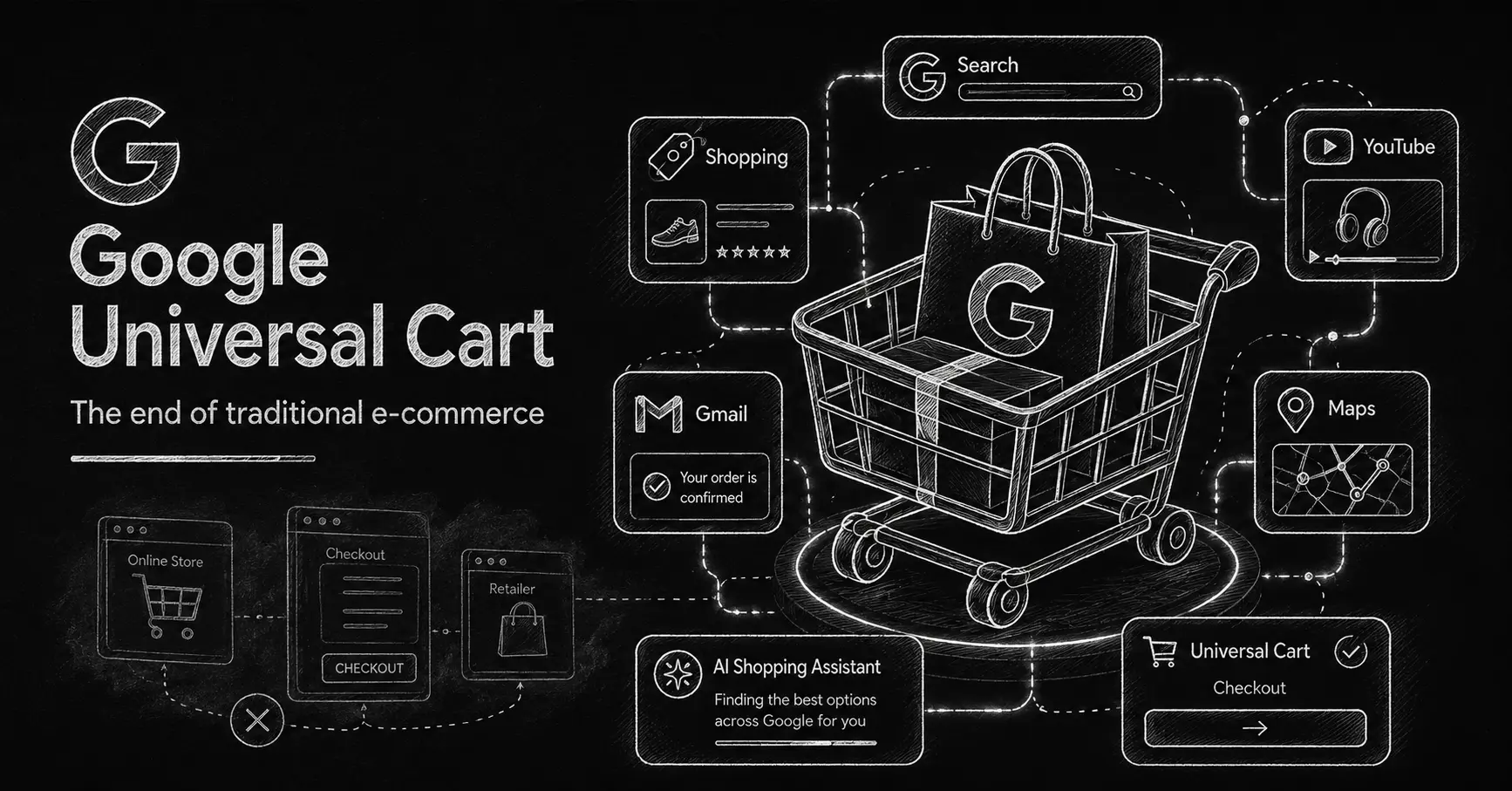
Google has confirmed Australia as one of the first markets for Universal Cart and the Universal Commerce Protocol (UCP). If you want to understand what Universal Cart is and why it matters, we covered that here.
This blog covers what’s new since that announcement – the UCP, the Expression of Interest process, and what changes for media buying and measurement.
While the initial launch will begin with a select group of retail partners before expanding more broadly across the market, the direction is clear: the traditional “search, click, website, checkout” journey is evolving.
Registering doesn’t guarantee onboarding, but it puts your brand in the queue as availability expands. Google has also opened an Expression of Interest process for retailers interested in Universal Cart participation. Businesses can register their interest directly with Google and will be considered for future onboarding opportunities as availability expands:
https://support.google.com/merchants/contact/ucp_integration_interest
Consumers will increasingly be able to discover products across Search, Gemini, YouTube and other Google surfaces, add products to a universal cart, and complete purchases with significantly less friction than today’s ecommerce experience.
For retailers, this isn’t just another Google product update. It’s the beginning of agentic commerce, and the window to prepare is now.
What is the Universal Commerce Protocol?
UCP is the infrastructure layer that makes Universal Cart work. It’s a standardised protocol that connects retailer inventory, pricing and fulfilment data directly to Google’s commerce ecosystem. Where Universal Cart is the consumer-facing experience, UCP is what powers it on the backend. Retailers will need to meet UCP data standards to participate – which is why feed quality and Merchant Center readiness are the right place to start now.
Feed Audits: The Highest Priority Action
AI shopping experiences rely heavily on structured product data to understand, recommend and transact products. Incomplete attributes, inconsistent taxonomy structures and inaccurate inventory data can limit visibility in emerging shopping environments.
Retailers should be assessing:
- Product title quality and optimisation
- Attribute completeness and enrichment
- Inventory accuracy and refresh frequency
- Product categorisation and taxonomy mapping
- Image quality and coverage
As AI-assisted shopping grows, your product feed and Merchant Center increasingly become your storefront.
At Pattern, we’re already helping brands identify feed gaps, enrich product attributes and optimise Merchant Center readiness ahead of broader rollout. The brands that invest in their product data foundations today will be best positioned as these new shopping experiences become more widely available.
We’ve already seen the impact strong product data can have for retailers. Through feed optimisation and product enrichment initiatives, Strand achieved a 38% increase in ad clicks, a 35% increase in free listings traffic and a 158% increase in Organic Product Grid keyword visibility. Read the full Strand case study here.
Technical Readiness Matters
Product data is only one part of the equation. Retailers should also evaluate whether their ecommerce infrastructure is prepared for increasingly connected shopping experiences.
Three areas stand out:
- Crawlability: Google’s systems need reliable access to product information, structured data and inventory signals.
- Checkout Readiness: Brands should assess guest checkout experiences, real-time inventory validation, shipping calculations and future API-driven checkout capabilities that may support more seamless purchasing journeys.
- Backend Infrastructure: As commerce becomes increasingly automated, data accuracy, API connectivity and platform responsiveness become more important than ever.
AI can’t recommend or transact products it can’t access, understand or validate. Pattern’s LLM Access Audit identifies exactly where your site is blocking AI crawlers and what to fix. Register here to get your complimentary LLM Access Audit.
What About Media Buying?
One of the most common questions following the announcement is whether Universal Cart will require a new campaign type.
Based on what Google has shared so far, retailers should expect Universal Cart opportunities to be enabled through existing commerce infrastructure, particularly Merchant Center and Performance Max, rather than through a standalone campaign type.
This reinforces why feed quality, Merchant Center health and conversion measurement are becoming increasingly important. Brands that already have strong commerce foundations will be best positioned as new shopping experiences become available.
Measurement Will Need To Evolve
One of the biggest unanswered questions surrounding Universal Cart is measurement.
The reality is that we won’t fully understand the reporting and attribution implications until the product is live and adoption begins to scale. If more transactions occur within Google’s commerce ecosystem, traditional metrics such as website sessions and traffic may become less representative of overall performance.
What we do know is that Google is continuing to invest heavily in measurement solutions such as Google Analytics and Meridian, its open-source Marketing Mix Modelling framework, signalling a future focused on business outcomes rather than browser-based attribution alone.
As Universal Cart rolls out, Pattern will be closely monitoring the impact on reporting, attribution and channel performance to help brands adapt accordingly.
Why YouTube & Demand Gen Become More Important
One of the most overlooked implications of Universal Cart is what happens before the transaction.
If checkout friction decreases, discovery becomes more valuable. Brands that build preference, trust and reliability earlier through YouTube, Demand Gen and other upper-funnel channels will be better positioned when AI-powered shopping experiences present recommendations to consumers.
As AI increasingly assists with product recommendations, the battle shifts from simply capturing demand to creating it. The brands that win tomorrow will be the brands consumers already know, trust and prefer today.
How Pattern Is Helping Brands Prepare
While the rollout is still in its early stages, preparation needs to start now.
Pattern is already supporting retailers with:
- Feed audits and enrichment
- Merchant Center optimisation
- One Search strategies across SEO, Paid Search, Paid Shopping, Performance Max, Demand Gen and YouTube
Want to understand how prepared your business is for Universal Cart? Claim your complimentary Universal Cart Discoverability Audit and discover how your product feed, Merchant Center setup and measurement framework stack up for the next generation of AI-powered shopping experiences