As artificial intelligence becomes central to the way people search and discover information online, with AI fragmenting the websites, they must adapt – not just for human users, but also for Large Language Models (LLMs) like ChatGPT, Gemini, and other advanced AI systems now shaping digital experiences.
At Pattern, we now offer an LLM Access Audit to assess whether your website is accessible, understandable, and technically optimised for this new generation of AI-driven search and discovery.
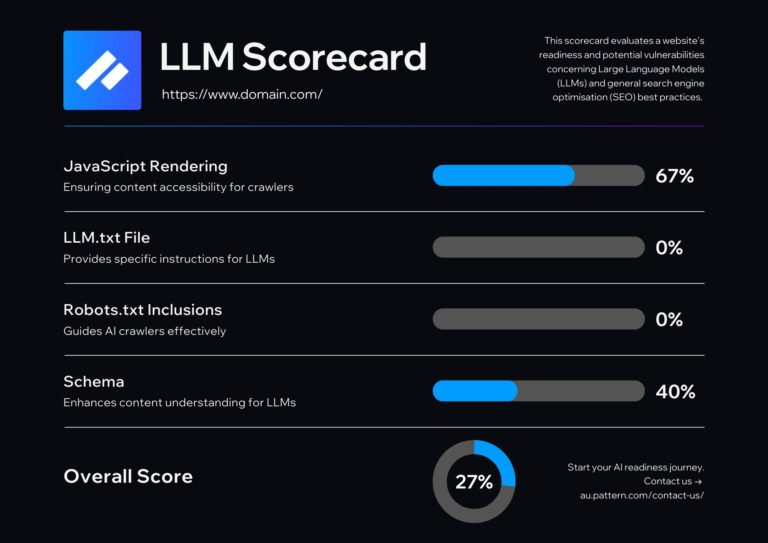
Click here to request your complimentary LLM Access Audit. Once your audit is complete, we will provide a clear, easy-to-understand scorecard showing precisely how your site performs in each key area.
Please note: The LLM Access Audit is only available to eligible brands with an Australian direct-to-consumer website.
What Is an LLM Access Audit?
An “LLM Access Audit” is a structured review focused specifically on how well a website is prepared for LLMs – the technology powering today’s most advanced AI search and discovery platforms. The purpose is simple: to evaluate the core technical elements that enable LLMs to access, understand and accurately represent your content.
What Does an LLM Access Audit Measure?
Our LLM Access Audit reviews the core areas that determine how accessible and understandable your website is for LLMs and other AI-driven technologies, scoring each pillar against current industry benchmarks. Benchmarks are based on Pattern’s audit of Australian DTC websites assessed in Q1 2025.
1. JavaScript Rendering
Are your key pages and information accessible to AI bots and crawlers, even if scripts aren’t loaded?

Many websites rely on JavaScript for essential features. If content like product details or navigation only appears after scripts run, most AI crawlers may not “see” it – reducing your visibility in AI-powered search.
Similarly, if key information about a product is hidden from AI, and a user asks information related to it, the AI will try to fill in the blanks by scraping 3rd party data or using its memory, which can lead a brand to lose control of its messaging and may surface negative sentiment or inaccurate information.
Benchmark: The average score is around 60%. While core content is often accessible, important navigation or supplementary sections are frequently missing when JavaScript is disabled.
2. LLM.txt File
Are you providing LLM-specific crawling instructions?
LLM.txt is an emerging standard designed to provide direct guidance to AI bots on what content to prioritise, avoid, or interpret using special rules – similar to how robots.txt directs search engines.
Benchmark: The average score is 0% – adoption is still extremely rare across the industry.
3. Robots.txt Inclusions
Are your crawler directives optimised for both AI and traditional search?
A well-configured robots.txt file allows the right content to be indexed while keeping sensitive pages private. It’s a basic, but vital, layer of control for how both classic and AI bots experience your site.
Security and privacy check: We also scan for exposed sensitive paths (e.g., /admin, /account, /checkout, CMS back‑ends, staging/preview) in robots.txt and sitemaps, and verify they’re gated or noindexed. Robots.txt isn’t security, so we flag potential leaks before AI crawlers pick them up.
Benchmark: The average score is around 80%. Most sites are generally well-configured but often have lingering blocks or minor gaps.
Learn more about how to manage OpenAI crawlers and how you can optimise your site for ChatGPT.
4. Schema
Is your structured data markup clear and complete?
Schema (structured data) helps AI and search engines interpret exactly what’s on your page – products, articles, FAQs, and brand info. The more precise your markup, the better AI platforms can serve and represent your site.
Benchmark: The average score is 50%. Partial schema coverage is typical, with many sites missing key types or comprehensive markup.
Why do these benchmarks matter?
Recent research highlights the impact of these foundational measures. For example, a recent study found that implementing LLM-specific technical optimisations – like llm.txt files, robots.txt, and schema.org markup – resulted in a 64% increase in brand mentions across major AI-powered search platforms. This demonstrates that well-structured, machine-readable content is now fundamental for maximising online discoverability and authority in the age of generative AI.
Why Do These Four Pillars Matter for AI Readiness?
JavaScript Rendering, LLM.txt, robots.txt, and Schema are widely recognised as the technical foundation of AI search visibility.
Here’s why each is critical for AI readiness:
- They Ensure Visibility: If your site’s content can’t be accessed or understood by AI models, it’s effectively invisible to AI-driven platforms – meaning crucial information may never reach users.
- They’re Future-Proof: These are not static requirements, but emerging best practices that reflect how LLMs and search engines are evolving. Early research from Hidayet Karamuk, suggests brands implementing these optimisations have seen significantly higher AI-driven brand mentions. Optimising for structured content, semantic clarity, and contextual understanding is rapidly becoming essential – not optional – for digital discoverability.
- They’re Measurable and Actionable: Each pillar represents a clear, fixable aspect of your website’s infrastructure. By tracking your scores, you can directly see and address areas impacting your digital reach.
- They’re Aligned with Real AI Behaviours: Modern AI search – from chat interfaces to direct answer engines – relies on well-structured, accessible data. These four areas map directly to how LLMs source, understand, and display information.
Together, these pillars represent the core technical essentials that support visibility, trust, and accurate representation in the new AI-powered web.
Leading academic and industry perspectives agree: For instance, Maria Cristina Enache (2025) highlights that clear, structured data, smart site architecture, and explicit technical signals (such as Schema.org and extraction-ready answers) are now central to success in answer-driven search. This shift – sometimes called “Answer Engine Optimisation” – is quickly becoming the new normal for brands hoping to grow online.
How Pattern’s LLM Access Audit Works
- Request the audit: complete the form with your domain and contact details.
- JavaScript rendering assessment
We load multiple testing pages twice – once with JavaScript and once with JavaScript disabled (HTML only). LLMs ingest both versions, and we compare what data is lost (e.g., prices, specs, navigation, pagination). If vital content only appears after scripts run, it’s flagged as at risk of being missed by AI crawlers, and the score is reduced. - LLM.txt discovery
We check /llm.txt and common variants for availability (HTTP 200), readability, and plain, unambiguous instructions for AI agents. If it’s missing or inaccessible, this pillar scores 0; if present, we note scope and clarity. - Robots.txt and crawler access
We fetch robots.txt and evaluate the rules against common AI user agents (GPTBot, Google‑Extended, OAI‑SearchBot, PerplexityBot, ClaudeBot). Access tests on sample URLs surface issues like blocked CSS/JS, disallowed critical paths, or missing sitemaps. Misconfigurations lower the score. - Schema (structured data) review
We parse JSON‑LD on the same pages and validate expected types per template (Organisation/Website/WebPage/BreadcrumbList; Product/Offer/Brand; Article/FAQPage/ItemList). Key fields are checked, and a quick validator pass is run, then we compare what an LLM can confidently extract (names, prices, attributes, FAQs). Missing or incomplete markup reduces the score. - Receive your scorecard: we’ll email your overall AI‑readiness score and per‑pillar scores (JavaScript Rendering, LLM.txt, robots.txt, Schema), benchmarked to industry averages. The audit is diagnostic; recommendations and implementation are optional.
Why use Pattern for your LLM Access Audit
- Purpose-built methodology focused on LLM access and understanding – not just classic SEO factors.
- Independent scoring with current industry benchmarks to prioritise what matters.
- Clear, neutral deliverable: a scorecard only; tailored recommendations and implementation support are available on request.
- Privacy-safe process: a read-only assessment with no changes made to your site during the audit.
Ready to improve your AI visibility?
Click here to register for the complimentary LLM Access Audit and receive your scorecard.
Frequently Asked Questions
An LLM, or Large Language Model, is an AI system (like ChatGPT or Google Gemini) designed to understand and generate human language at scale.
In artificial intelligence, an LLM is a type of model trained on large volumes of text to summarise, answer questions, and power next-generation search engines.
An LLM Access Audit is a technical assessment to determine whether your website is accessible and comprehensible to modern AI models, helping you see which information is being picked up and which may be missed.
LLMs are trained on enormous datasets and advanced algorithms, enabling them to predict, generate, and extract information from human language, making them central to new forms of search.
An llm.txt file is a new emerging standard that provides specific instructions to AI bots on which parts of a website to focus on or skip, helping brands guide AI-powered discovery.
Robots.txt is the long‑standing standard that tells crawlers which URLs they may or may not access; most compliant search engines and many AI bots honour it. llm.txt is an emerging, optional guidance file for AI/LLM agents about what to prioritise, summarise, or cite – it doesn’t reliably block access and should be used alongside robots.txt.